 RapTor
WeTheNorth Onion Link: Why a Single Address Is Riskier for This Market Than for Any Other
WeTheNorth runs on exactly one onion address, no mirrors — a design choice every other market on this site's directory avoids for good reason, and one that makes getting the WeTheNorth onion link right on the first try more important here than almost anywhere else. It's also the only market RapTor reviews that serves one country specifically — some sources render the name as "We The North" — and the only one with a documented predecessor that regulators actually shut down and fined. Below: the address, its current reachability status, the single-address risk in full, and what a Canada-focused market actually changes for a buyer, in the same depth as any other market review on this site.

The address
WeTheNorth runs one onion URL and no mirrors. This is it.
hn2paw7blozw7vsk74nhxl6oufnosv62dapciepdtitufeg6xwx2bkad.onion- Get WeTheNorth's PGP key and current signed address announcement from its own Dread presence — not from a search result, not from a directory's page of links, and not from the clearnet front covered below.
- Check the fingerprint against a second, independently obtained copy, then the signature on the announcement — PGP on the dark web walks through both.GnuPG documentation Because there's no second mirror to cross-reference against, this signature check is the only verification you get — there's no "try the other four and see which ones agree" fallback the way there is on TorZon.
- Always access the onion address through a verified copy of Tor Browser, even though a clearnet option exists — see below for why that matters more here than the convenience is worth.
Why one address makes lookalike domains more dangerous
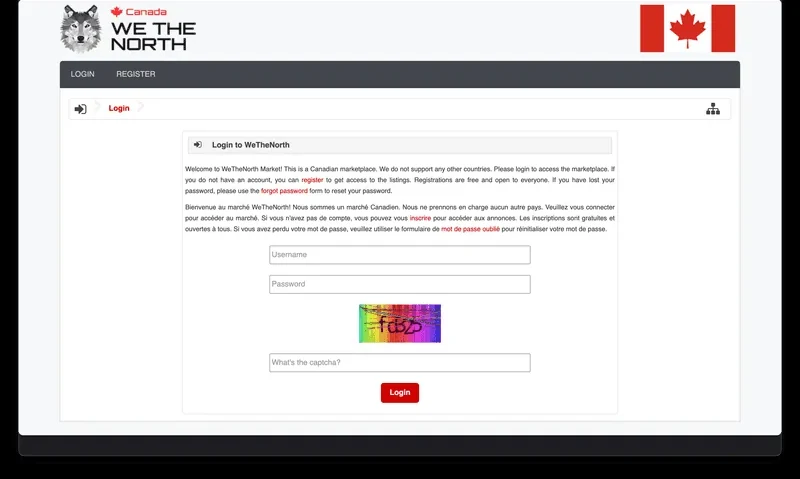
Every mirror a market publishes is also a backup: lose one to a takedown or a DDoS campaign and the others keep working. WeTheNorth has no such backup — a single onion address, confirmed by the one reviewer to check it directly, which "makes Canadian-targeted phishing clones unusually easy to pass off as genuine," since a buyer with no second address to compare against has nothing to sanity-check a fake against except the signature itself.TorWiki On a sixteen-mirror market like TorZon, an obviously wrong address stands out against fifteen consistent ones; on a one-address market, there's no crowd to stand out from, and the PGP signature check becomes the entire verification, not merely the final step of it. Treat that as reason to slow down rather than speed up — the absence of alternatives is exactly what a convincing single fake is counting on.
The reported clone and shadow-infrastructure problem
A threat-intelligence investigation into WeTheNorth's online footprint found the market's identity spread across its official presence, look-alike domains, and what researchers describe as shadow infrastructure — a pattern consistent with active, ongoing impersonation rather than a one-off phishing attempt.StealthMole That finding lines up with the market's own structural weak point: a single address and, as covered next, a clearnet presence, together give a phishing operator two separate surfaces to imitate rather than one, and a buyer who isn't specifically looking for this brand's phishing history has no way to know it's an active, ongoing problem rather than a hypothetical risk.
The clearnet front, and what using it costs you
WeTheNorth is reachable both through its onion address and through a standard clearnet domain — unusual among the markets on this site, and reported as a deliberate accessibility choice aimed at buyers who find Tor intimidating.TorWiki The convenience is real: no browser configuration, no circuit delays, nothing that reads as unusual to someone unfamiliar with onion addresses. The cost is just as real and less visible: clearnet traffic is inherently more observable than Tor traffic, an ISP can see which domains you visit even if it can't see the page content, and the market's clearnet infrastructure is simply more attack surface than a Tor-only platform carries. One reviewer's own recommendation is unambiguous: always reach WeTheNorth through the onion address, never the clearnet front, because "the convenience gain does not justify the OPSEC cost."TorWiki That recommendation matters more here than it would for a market without a clearnet option at all, precisely because the option exists and is easy to reach for under time pressure.
What WeTheNorth is
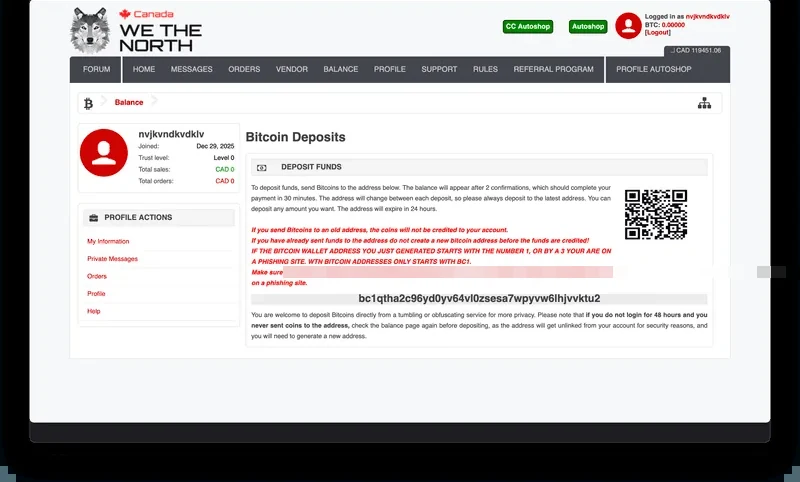
WeTheNorth launched in 2021 as a Canada-focused market and remains, by every account covering it, the only bilingual darknet market currently operating — full English and French support extending beyond a translated interface to vendor communications and community discussion, serving Quebec's French-speaking user base directly rather than through machine translation.TorWiki The market displays roughly 8,000 to 9,000-plus listings, concentrated most heavily in drugs and chemicals, with fraud, counterfeit items, digital products, and carded goods filling out the rest of the catalogue.SOCRadar Beyond a straight marketplace, WeTheNorth bundles a built-in Autoshop for instant automated delivery of digital goods, an internal forum tied to the same vendor-reputation identities rather than a separate Dread presence, and — unusually for this niche — a sports betting feature letting users wager using their market wallet balance.TorWiki
Payments and escrow
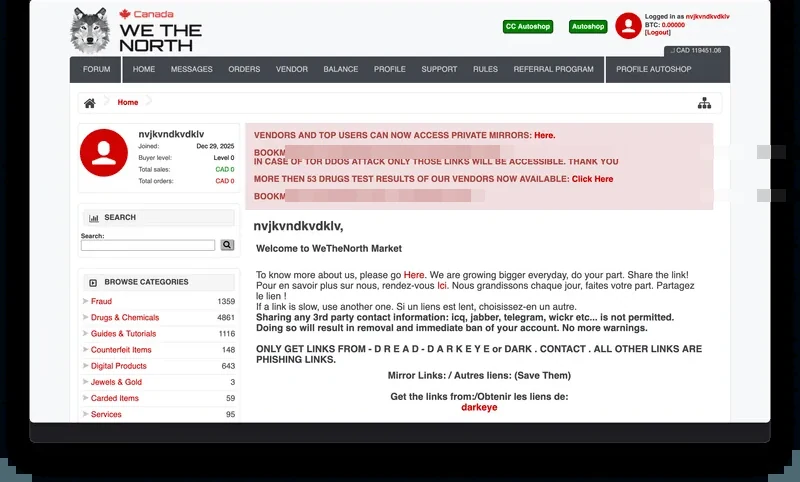
WeTheNorth accepts both Bitcoin and Monero, settled through traditional market-side escrow with no early-finalization option reported — which is, on its own, more buyer-protective than a market that lets a vendor push for early release, since a buyer here always retains the right to confirm receipt before funds move.TorWiki That protection stops at the payment layer, though: Bitcoin's ledger is permanent and public, and has repeatedly been the deciding piece of evidence in identifying buyers and vendors on other markets,Chainalysis while Monero hides the sender, receiver and amount of a transaction by default.getmonero.org If you're paying with Bitcoin here because that's what you already hold from an exchange, the Monero guide covers converting first rather than leaving a permanent record tied to a Canadian-shipped order specifically, which narrows the pool of plausible senders more than the same transaction would on a market with international buyers.
How big it is, and why the count isn't verified
The 8,000-to-9,000-plus listing figure is explicitly labeled by the source reporting it as a marketplace-displayed estimate rather than an independently verified countSOCRadar — the same limit that applies to every listing count on RapTor's directory, restated plainly here because WeTheNorth's own reviewer is more careful about the caveat than most. Nobody outside the platform can confirm how many of those listings represent active, fulfillable inventory versus stale or duplicate entries, and the count reflects whatever the market's own dashboard shows at the moment someone checked it, not an audited total.
The CanadianHQ lineage, and what actually happened to it
WeTheNorth's origin is tied to Canadian HeadQuarters — also called CanadianHQ or, in some sources, CanadaHQ — a Canadian darknet marketplace that specialized in spamming services, phishing kits, stolen credentials, and access to compromised computers.CRTC, 26 Jan 2022 Canada's broadcasting and telecommunications regulator, the CRTC, executed warrants against the operation through 2020 and 2021, taking the marketplace offline, and in January 2022 announced penalties totaling $300,000 against four Canadians under Canada's Anti-Spam Legislation: $150,000 against Chris Tyrone Dracos, described as the platform's creator and administrator, and $50,000 each against three others identified as vendors on the platform.CRTC, 26 Jan 2022 The CRTC's own statement called it "one of the most complex cases" the agency had handled since the anti-spam law came into force, crediting cooperation from a cybersecurity firm and Canadian federal and provincial police.CRTC, 26 Jan 2022 That regulatory enforcement action is a different animal from the criminal seizures covered on the takedown ledger — a telecommunications regulator levying anti-spam fines, not a police raid on market infrastructure — and it's worth knowing that distinction exists before assuming every Canadian dark-web enforcement story follows the same playbook. When CanadianHQ went offline, its vendor community needed a new home, and WeTheNorth is reported to have absorbed that migration quickly — former vendors bringing established shipping networks and customer relationships that would otherwise take years to rebuild, which is credited as part of why WeTheNorth's top-rated sellers today carry multi-year transaction histories.TorWiki
What a regional market actually changes
Beyond the language support, WeTheNorth's Canadian focus shows up in practical terms a global market can't easily replicate: vendors shipping domestically within Canada avoid the customs-inspection exposure that comes with international parcels, pricing displays in CAD rather than forcing a mental currency conversion, and a smaller, more interconnected user and vendor base makes reputation and community accountability tighter — a scam vendor is more likely to be identified quickly when the pool of active Canadian sellers is small enough for regulars to recognize names.TorWiki The trade-off mirrors what BlackOps's smaller footprint costs its buyers: WeTheNorth's regional focus means no real competition for readers outside Canada, or for anyone who values international selection over domestic shipping speed and cultural familiarity.
Where WeTheNorth is weak
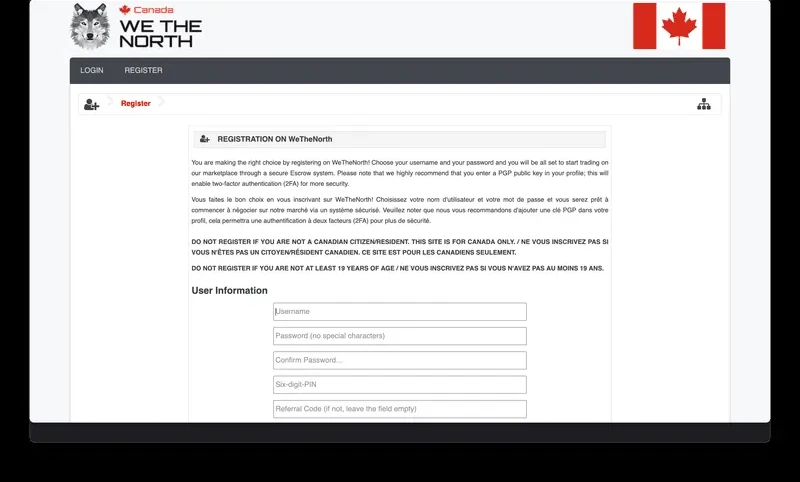
Security fundamentals lag behind every general-purpose market on this site's directory: no two-factor authentication is reported as available at all, leaving account security resting entirely on password strength, and no multisig escrow exists here either.TorWiki The absence of 2FA is a sharper problem on a market that also offers clearnet access, since clearnet users are more exposed to DNS-level manipulation and phishing than Tor users are, and a phished password with no second factor to stop it is complete account access. One reviewer notes WeTheNorth effectively has no direct competitor — there is no other Canadian-focused, bilingual darknet market to compare it against — and argues that this lack of competitive pressure may be exactly why gaps like missing 2FA have gone unaddressed for years after launch.TorWiki Combine the single-address design covered above with no second authentication factor, and the practical takeaway is straightforward: this market rewards extra verification discipline precisely where it offers the least redundancy to fall back on if something goes wrong.
If Canadian-specific shipping and bilingual support aren't the priority and broader selection matters more, TorZon and Nexus both serve an international buyer base with considerably more built-in redundancy. And where DrugHub is currently facing a live, unresolved dispute from its own users, WeTheNorth's documented risk is structural and design-level rather than an active, contested accusation — a different kind of caution, worth reading as such rather than treating every market's risk profile as the same shape.