 RapTor
Nexus Onion Link: Why Three Directories Disagree, and the One Check That Settles It
Search for the Nexus onion link and you'll find several review sites confidently publishing what they call the verified address — and if you open three of them, you'll find three overlapping but not identical address sets, one site that explicitly refuses to mark Nexus PGP-verified at all, and no acknowledgment anywhere that the others exist. That disagreement is the actual story on this page, more useful than any single address, because it points at the one check that resolves it regardless of which directory you started from. Whether Nexus is "legit" isn't a question any outsider on the wider dark web can settle with certainty, and no uptime status one directory reports is independently confirmed — what follows is reachable over Tor safely — see the Tor Browser guide if you haven't set that up yet — and reviewed on what can actually be checked.

Which Nexus address is the real one
Here is an address for Nexus. Treat it the way you should treat every other one in circulation for this market — as a candidate rather than an answer — because three directories publish three overlapping but different sets of links and not one of them acknowledges that the other two exist. The steps below turn a candidate into a confirmed address, this one included.
nexusck4c5hrdikdhoyh5jxuxzrcm2cfqlk5saqwdkdosu7irbraqgyd.onion- Expect disagreement, and don't resolve it by picking whichever source looks most polished. One review site tracks three Nexus mirrors and states plainly that it has not been able to verify a multisig flow or confirm PGP is co-published with the address at all — a more cautious posture than sites that print a confident feature table.Zero Trace Hub Another tracks a slightly different three-address set under a "verified as of June 2026" banner.tordark.com A third lists yet another three addresses as of September 2026.TorWiki None of the three references the other two's list.
- Import Nexus's PGP key from a source independent of whichever page handed you a URL — not the same page, and ideally not from any single review site at all, since a signing key posted only on a directory is exactly as trustworthy as that directory's own operational security.
- Find Nexus's own signed mirror announcement — typically posted to its Dread presence — and put both the key and the announcement through the routine on PGP on the dark web: all forty characters of the fingerprint against a second independent copy, then the signature itself.GnuPG documentation A matching first block of characters is not a match, and this is the step that actually settles which address set is genuine: whichever addresses appear on the list signed by the key you independently verified are the real ones, regardless of which directory printed them first or most confidently.
- Discard any address that isn't on that signed list, including ones you found on this page's sources above. A directory can be honestly wrong or dishonestly wrong; the signed list doesn't care which.
Why three directories publish three different address sets
This isn't necessarily bad faith — it's closer to three snapshots of a moving target taken at different times, none of them cross-checked against the others. Nexus rotates mirrors, so a set captured in May will legitimately differ from one captured in September even if both were accurate the day they were published. But two of the three review sites here do share two addresses in common, while a third address from one list differs from the closest match on another list by a single character — and under the math that makes a `.onion` address a public key rather than a name, explained on how onion services work, that one-character difference is not a rounding error. It is either a copy-paste mistake on one directory's part, or it is a phishing address that has been sitting in a "verified mirrors" list for however long nobody checked closely. Neither possibility is reassuring, and the only way to know which is true is the signature check above — not comparing the strings by eye.
What Nexus is
Even Nexus's own basic history is disputed across the sources that review it: one dates its launch to 2023,Zero Trace Hub a second agrees on 2023,tordark.com and a third puts it in 2024.TorWiki Reported size disagrees even more sharply: one directory cites "a reported 40,000" listings, while another puts current active listings at "4,000+" — an order of magnitude apart, from sources describing the same market in the same general period.tordark.comTorWiki RapTor is not going to invent a tiebreak between those two numbers; both are the market's own displayed figures or a directory's read of them, filtered through the same unauditable-dashboard problem covered on the darknet markets overview, and neither is independently confirmed the way TorZon's post-Abacus position is. What the sources agree on is the shape of the market: a general-purpose catalogue with a lighter emphasis on digital goods, security tooling, and professional services than the drug-heavy markets on this list, sold through an interface reviewers consistently describe as clean and modern.Zero Trace Hubtordark.com
The Autoshop and the mode switch
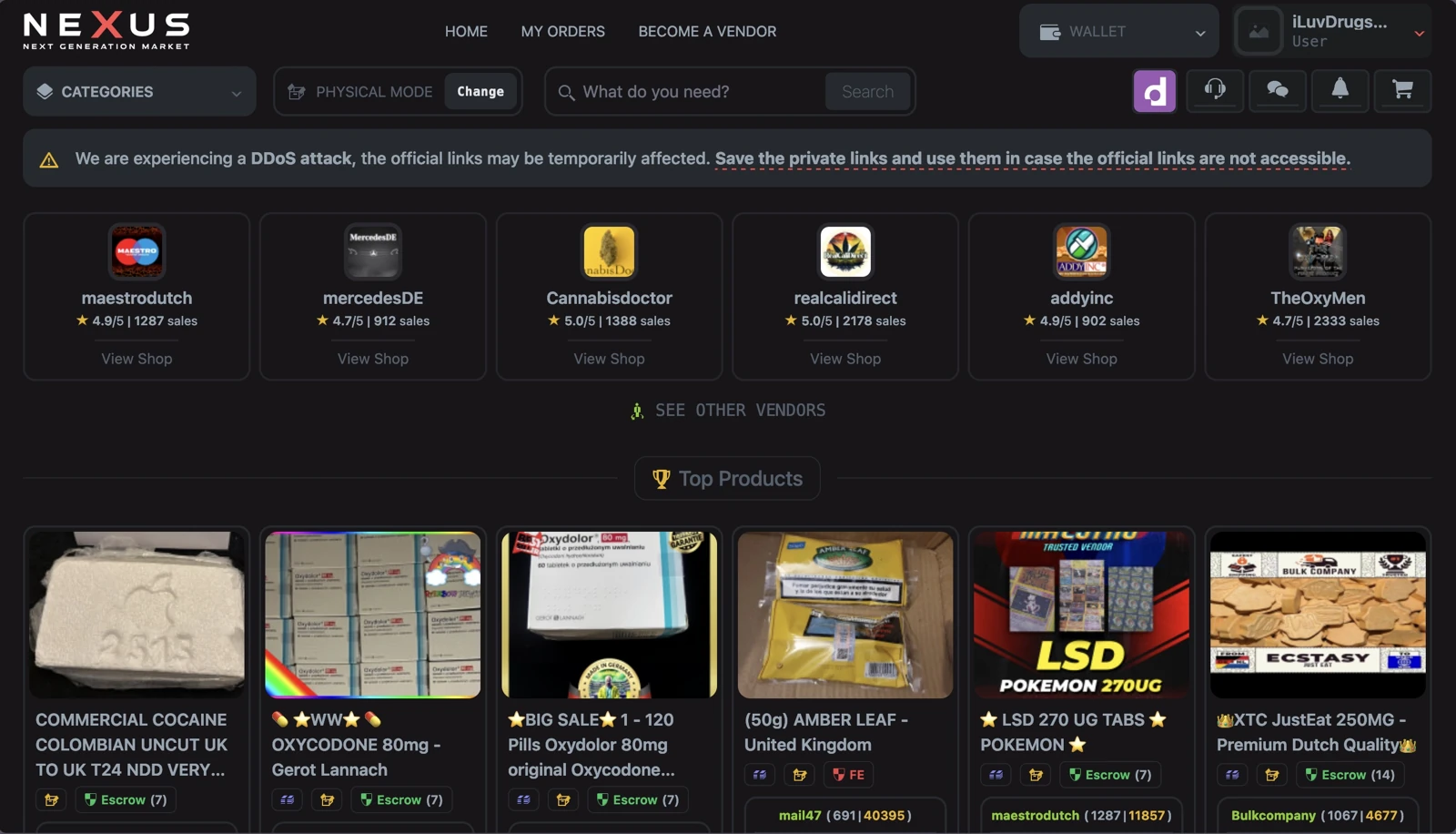
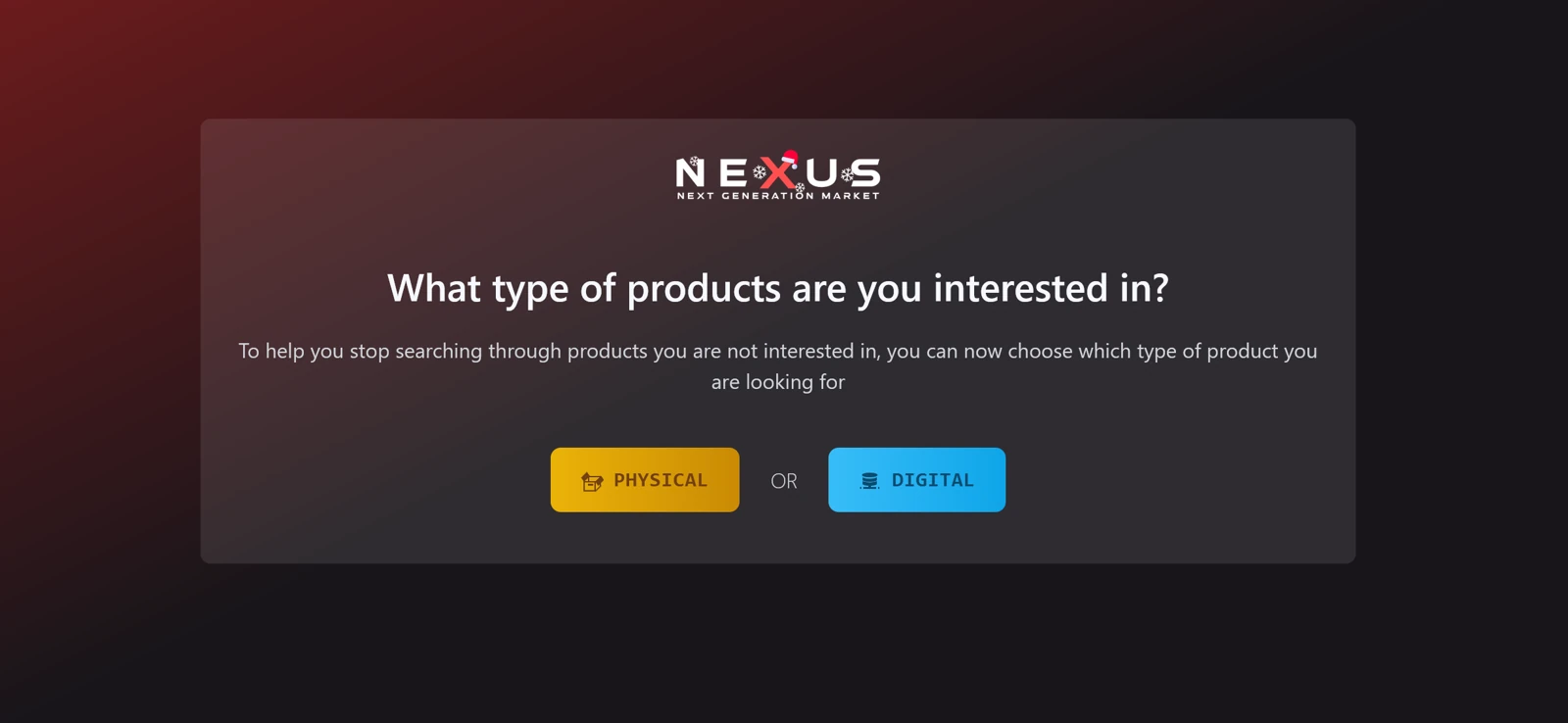
Two features explain why Nexus reads as more built-out than most of its peers. A mode switch on the homepage splits the market into physical and digital sides, keeping drug and physical-goods listings separate from digital ones so a large catalogue stays navigable rather than dumping everything into one tree.tordark.com The Autoshop is a storefront specifically for digital goods, where a vendor preloads inventory and the platform delivers it automatically and instantly on payment, with no vendor action required.tordark.com That instant delivery is a real convenience for legitimate digital-goods vendors, and it's also a sharper version of the verification problem this whole page is about: an automated, instant transaction has no human moment where a scam would normally show itself. If you're on a clone running its own copy of an Autoshop interface, the transaction completes exactly the same way — it just takes your coins and delivers nothing, with nobody to dispute it with, because there was never a real vendor behind it. Confirm the address before you ever reach an Autoshop checkout, not after.
The mnemonic and the withdrawal PIN: protection and bait
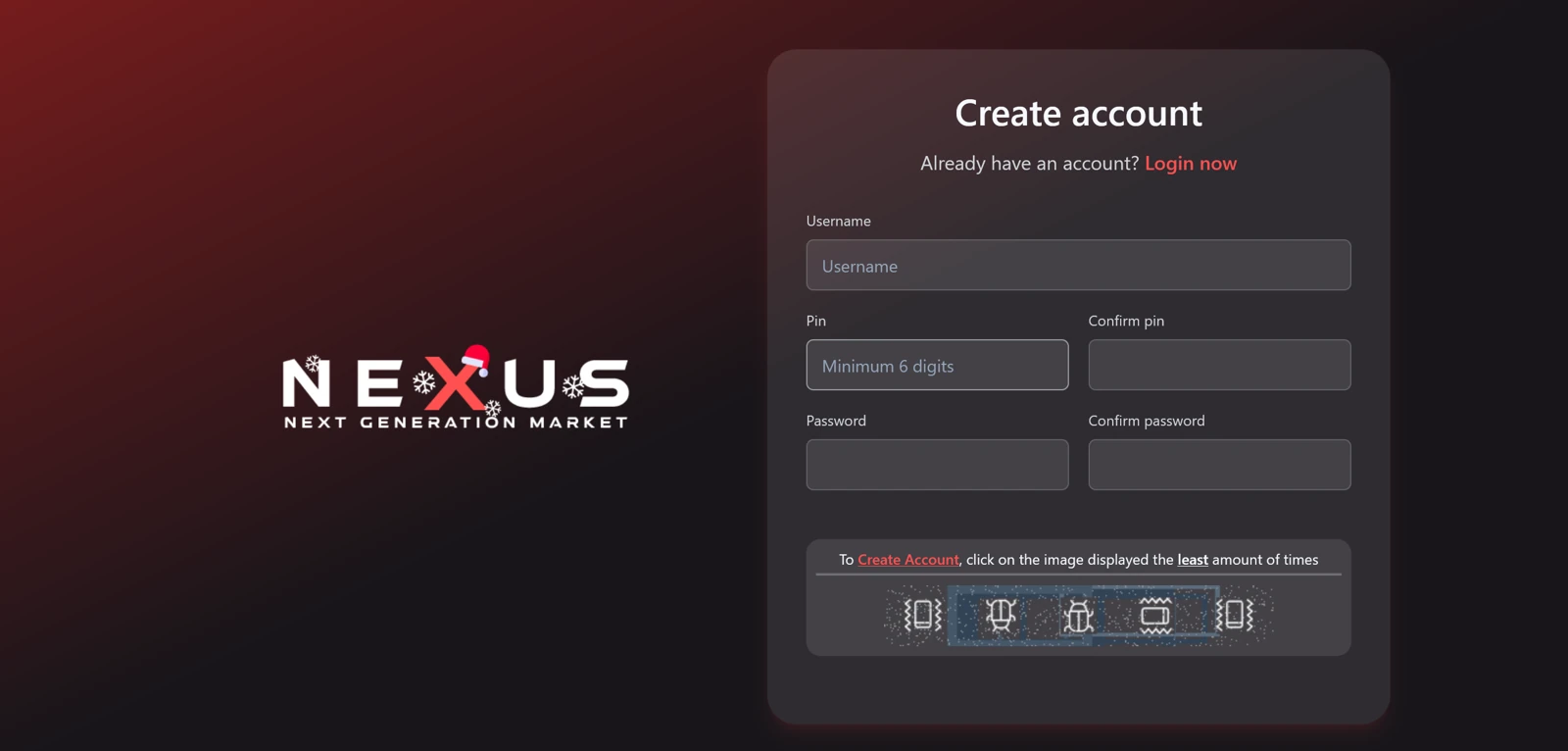
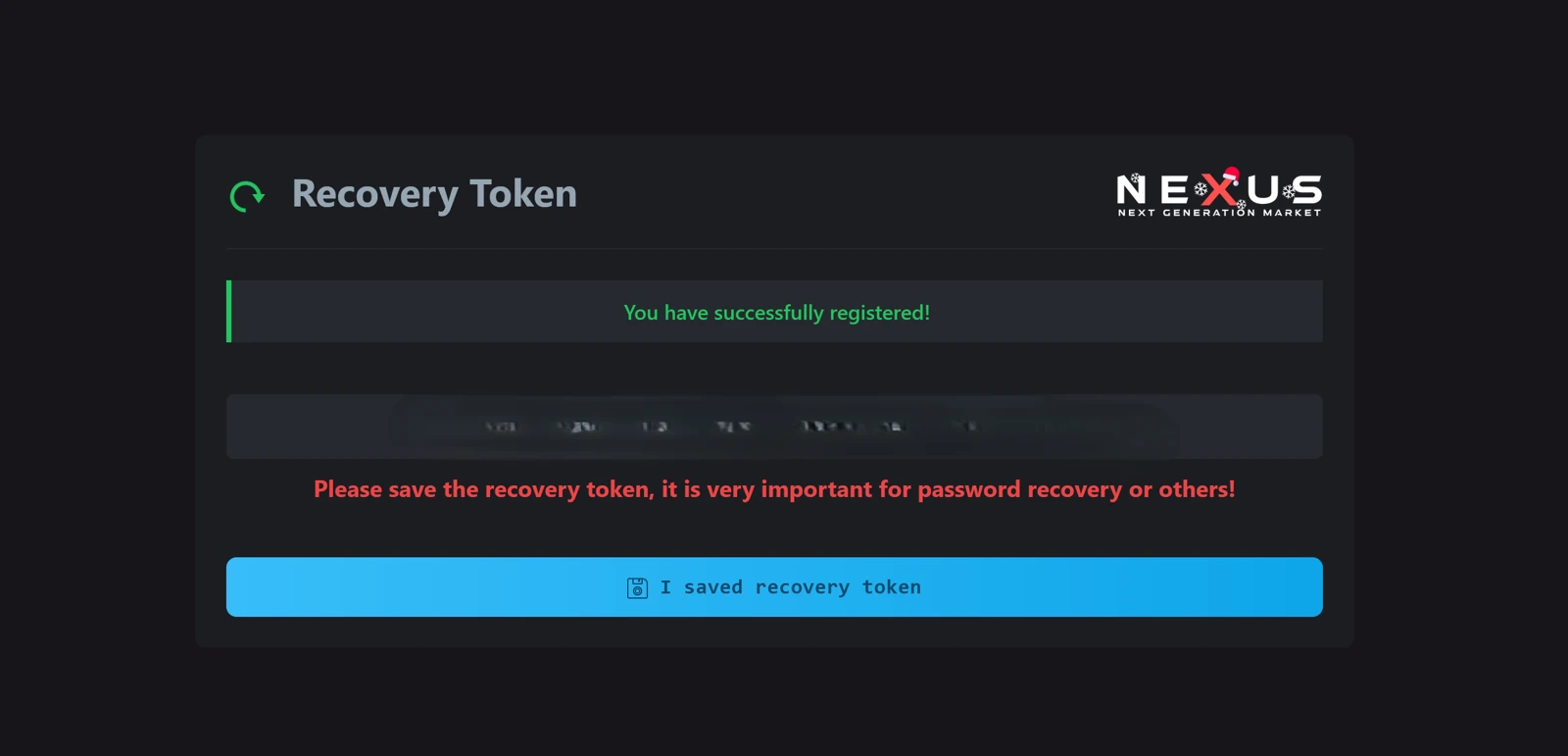
Nexus's account setup goes beyond a username and password: registration sets a separate PIN specifically for withdrawals, so a stolen login alone can't move funds, and issues a unique mnemonic recovery phrase for restoring account access.tordark.com Both are genuine protections against the ordinary failure mode of a compromised password. Both are also exactly what a phishing clone of the login or registration screen exists to harvest, because a mnemonic that recovers an account is, in practice, as powerful as the account itself — whoever holds that phrase can take it over regardless of your password. Store it offline, never in a screenshot, a synced note, or a password manager entry you access from the same browser session, and never type it into any page you have not independently verified through the signature check above, registration flow included.
Coins and the built-in wallet
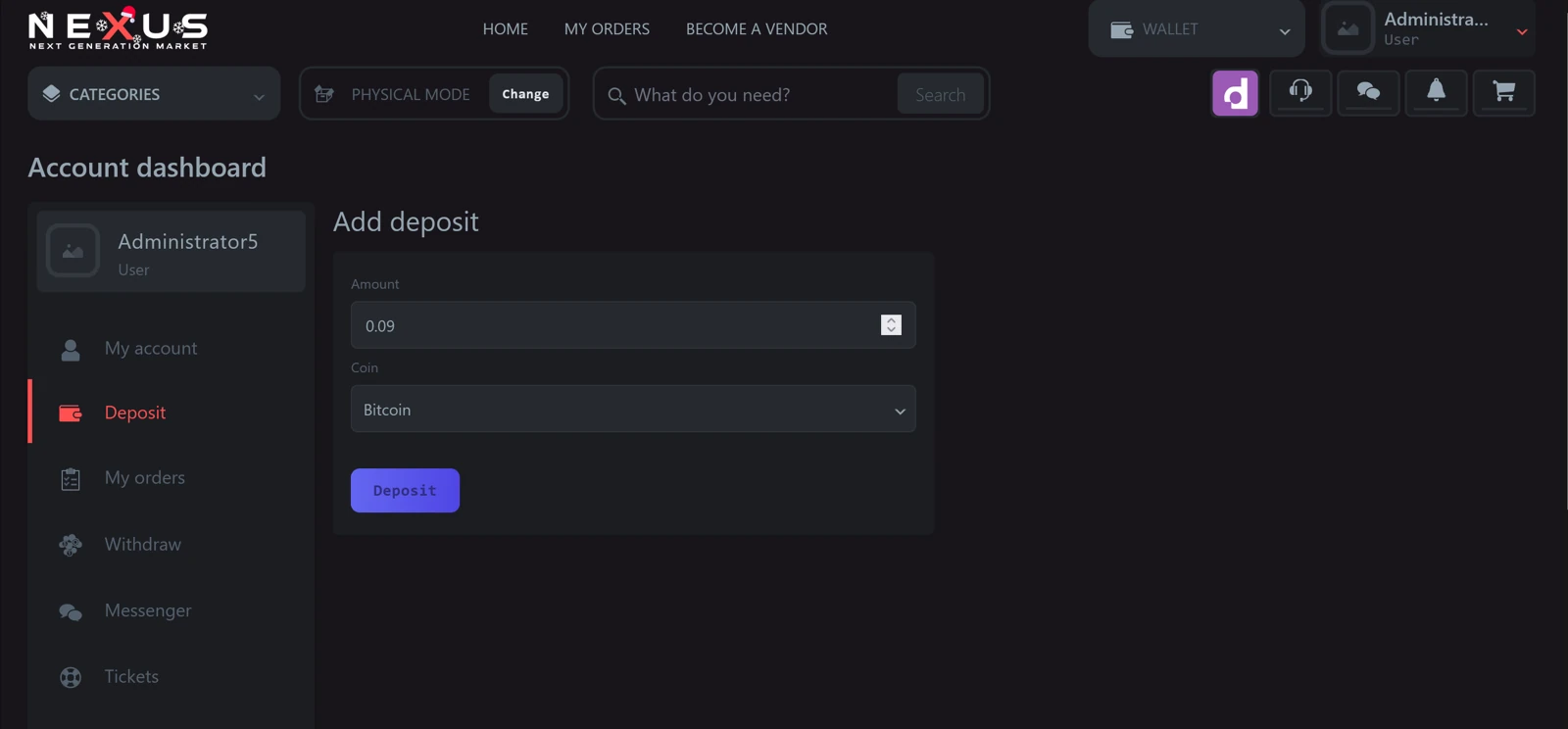
Nexus is the only market on this list reported to take three cryptocurrencies — Bitcoin, Monero, and Litecoin — funded either by pre-depositing into a built-in market wallet or paying directly per order.tordark.com One reviewer notes Bitcoin support is unconfirmed as of their last check, which is itself part of the pattern of disagreement here.Zero Trace Hub The choice among the three is not neutral: Bitcoin's permanent public ledger has repeatedly been used to identify buyers and vendors after the fact,Chainalysis so Monero is the lower-exposure default if you transact here at all — see the Monero guide for acquiring it without tying the purchase to an identity. The built-in wallet is the more convenient option and the riskier one: a balance sitting on Nexus's servers is a balance Nexus's operators control, not you, so fund only what an open order actually needs and withdraw the rest.
Disputes and finalize-early
Nexus runs traditional market-side escrow, with finalize-early available only to vendors who've reached top-tier status through a sustained, dispute-free history — new vendors cannot request it under any circumstances, which limits (without eliminating) its use as a fresh-vendor scam vector.TorWiki One reviewer describes Nexus's dispute process as unusually fast, typically resolved within hours rather than the multi-day queues common elsewhere, following a structured evidence-submission workflow before a moderator issues a binding decision.TorWiki Faster resolution is a genuine buyer-protection feature if accurate — but it's also, like every other Nexus statistic on this page, reported by exactly one source with no independent way to confirm the median case rather than the cases a market chooses to highlight.
What "vendor vetting" is worth without an audit
Nexus is described as running a multi-step vendor review — PGP key verification, cross-market reputation checks for migrating vendors, a probationary period with no finalize-early privileges, and product-sample verification for some categories.TorWiki That process, if it works as described, should mean fewer scam listings reach the catalogue at all, and it's plausibly the source of the smaller listing count relative to TorZon's volume-first approach. But "vetting" on a market nobody outside its own staff can audit is a claim about a process, not a result you can check — there is no published rejection rate, no third party confirming the probationary period is actually enforced, and no way to distinguish a genuinely rigorous vetting program from marketing copy describing one. Weigh it as a plausible design choice consistent with the market's other buyer-protection features, not as a guarantee.
How a dispute actually runs
One reviewer lays out Nexus's dispute process as a four-step workflow: the buyer opens a dispute within a stated window — typically 14 days from purchase — both sides submit evidence such as shipping confirmations and PGP-signed messages, a moderator reviews and issues a binding decision, and funds move accordingly, either back to the buyer or on to the vendor.TorWiki The interface itself is described as cleaner than most competitors, with search filters spanning price, vendor tier, and shipping region, and vendor profiles surfacing trust metrics at a glance.TorWiki None of that changes the underlying custody model — the market still holds the money while a dispute is open — but a documented evidence-based process is a real difference from a market that resolves disputes as an unstructured back-and-forth with support.
Nexus against the other buyer-protection question
| Property | Nexus | TorZon | BlackOps |
|---|---|---|---|
| Coins | BTC, XMR, LTC (BTC support unconfirmed by one reviewer) | BTC, XMR | XMR only |
| Mirrors reported | 3–4 | 16 | Single address, no clearnet front |
| Escrow | Traditional; FE for top-tier vendors only | Traditional; FE for top-tier vendors only | Traditional |
| Multisig | Not available on any account | Not available | Not available |
| Vendor entry model | Multi-step vetting, described as most rigorous of the three | Open with PGP requirement; tier system after entry | Screened before listing |
The pattern worth noticing: not one of the six markets on RapTor's directory runs multisig escrow, Nexus included, despite DarkMatter's marketing suggesting otherwise elsewhere in this niche. If multisig custody is a hard requirement rather than a preference, DarkMatter is currently the only market reviewed here that claims it.
Where Nexus is weak
Mirror count sits at three to four across the sources that count it — thin redundancy next to TorZon's sixteen, meaning fewer alternatives if the primary address is knocked offline or seized.TorWiki No multisig escrow is available on any account of Nexus; every dollar in the system is held under the platform's own custody.TorWiki And unlike TorZon or DarkMatter, none of the reviewing sites shows Nexus publishing a PGP fingerprint on the same page as its address — one states this outright as the reason it withholds a "verified" label.Zero Trace Hub No source ties Nexus to a seizure or an exit scam, but a clean record on an unaudited market is not the same claim as a safe one — it just means nothing has surfaced publicly yet. That gap is exactly what makes independent verification, rather than trusting any single site's confidence, the load-bearing step on this page.
If Nexus's buyer-protection focus isn't the fit and catalogue size matters more, TorZon is the larger, higher-mirror-count alternative with the same lack of multisig. For a market that resolves the multisig gap directly, see DarkMatter.