 RapTor
DarkMatter Market Archive: What It Was Before the September 2026 Exit

Run dates and how it ended
DarkMatter launched on 28 July 2022 under a founder and systems administrator known as Blackmask. By late August 2026 its own dashboard claimed 1,494 days online — a run the administrators described as among the longest of any darknet market, though that ranking was the market's own claim, not an audited one. In mid-September 2026 withdrawals stopped clearing. Mirrors dropped, came back, and stayed up long enough for users to log in and see balances that would not move. No seizure banner appeared. No administrator was named. RapTor stopped treating DarkMatter as an active market at that point and archived this page on .
Why there is no link here anymore
While DarkMatter was live, this page carried an onion address and a verification routine — PGP fingerprint, signed mirror list, the full check described on PGP on the dark web. Publishing a dead address helps nobody except whoever is hosting a clone at it now. After an exit scam, the honest move is to remove the link entirely and leave a warning instead.
That warning matters because dead markets attract more phishing than live ones. Clearnet domains, fake subreddits, and forum posts offering "the real DarkMatter URL" multiply the moment a well-known name goes offline — a pattern documented on r/onions long before this exit, when scammers stood up a fake community space under DarkMatter's name in the wake of another market's shutdown.r/onions A market that ran for four years left a large pool of people who bookmarked an address, remember the interface, and will search for a way back in. Every one of those search results is now someone else's opportunity. If you still have a DarkMatter bookmark, delete it. If someone sends you a link, assume it is a trap. There is no queue to rejoin and no maintenance window to wait out.
What DarkMatter was
The team said its early growth coincided with an approximately three-month Dread outage that made the market's first period harder than usual to establish — if accurate, that would mean four years of continuous operation from a genuinely difficult start rather than a smooth one. The catalogue split into physical listings — cannabis, ecstasy, psychedelics, stimulants, dissociatives, opioids, prescriptions, benzodiazepines and more — and a digital side covering fraud tools, guides, hosting and security services, and malware. Among the markets RapTor reviewed while it was running, DarkMatter was the only one that offered optional 2-of-3 Monero multisig alongside ordinary pooled escrow — a real design difference, and one whose limits became obvious when the market exited with whatever was still sitting in standard balances.
The figures it published, and how far apart they were
As of 31 August 2026 — the last snapshot RapTor had before the exit — DarkMatter's own displayed statistics showed roughly 142,000 users, 1,820 vendors, 35,000 listings and 431,000 completed orders. A separate directory covering the wider market landscape put DarkMatter's listing count closer to 3,000 for roughly the same period — an order of magnitude below the market's own number.TorWiki Neither figure was independently auditable: one was the market's own dashboard, which nothing stopped an operator from inflating, and the other was a third-party count that may have used a narrower definition of "active listing," worked from a stale snapshot, or simply worked from bad data. Outside coverage at the time put the same caveat on those figures: market-reported statistics, not independently verified measurements. Archived now, they are a record of what the market claimed about itself, not a measure of what was lost in the exit — and nobody outside the operators knows the real escrow total either way.
Monero-only payments
DarkMatter accepted Monero exclusively — no Bitcoin path existed on the market at all. Monero hides the sender, receiver and amount of every transaction by default, through stealth addresses, ring signatures and RingCT — a materially different privacy posture from Bitcoin's public, permanent ledger.getmonero.org Buyers who arrived holding Bitcoin had to convert first; the Monero guide still covers doing that without creating a direct, traceable link between an exchange KYC record and a market deposit, for markets that remain active.
2-of-3 multisig, and what it actually protected
DarkMatter offered three payment mechanisms: standard escrow, multisignature payments, and finalize early. In ordinary escrow, the market held funds alone until it decided to release them — meaning the operators, and only the operators, could move the money at any time. In 2-of-3 multisig, funds were locked behind three keys — commonly the buyer's, the vendor's, and the market's — and moving them required any two of the three parties to agree, so the operators could not unilaterally drain an order placed through that option. DarkMatter's administrators said the market was among the first to offer Monero multisig specifically. The option sat on the browse page as a toggle alongside Escrow and FE; whether an order actually used multisig depended on which switch the buyer turned on, not on the market merely offering it.
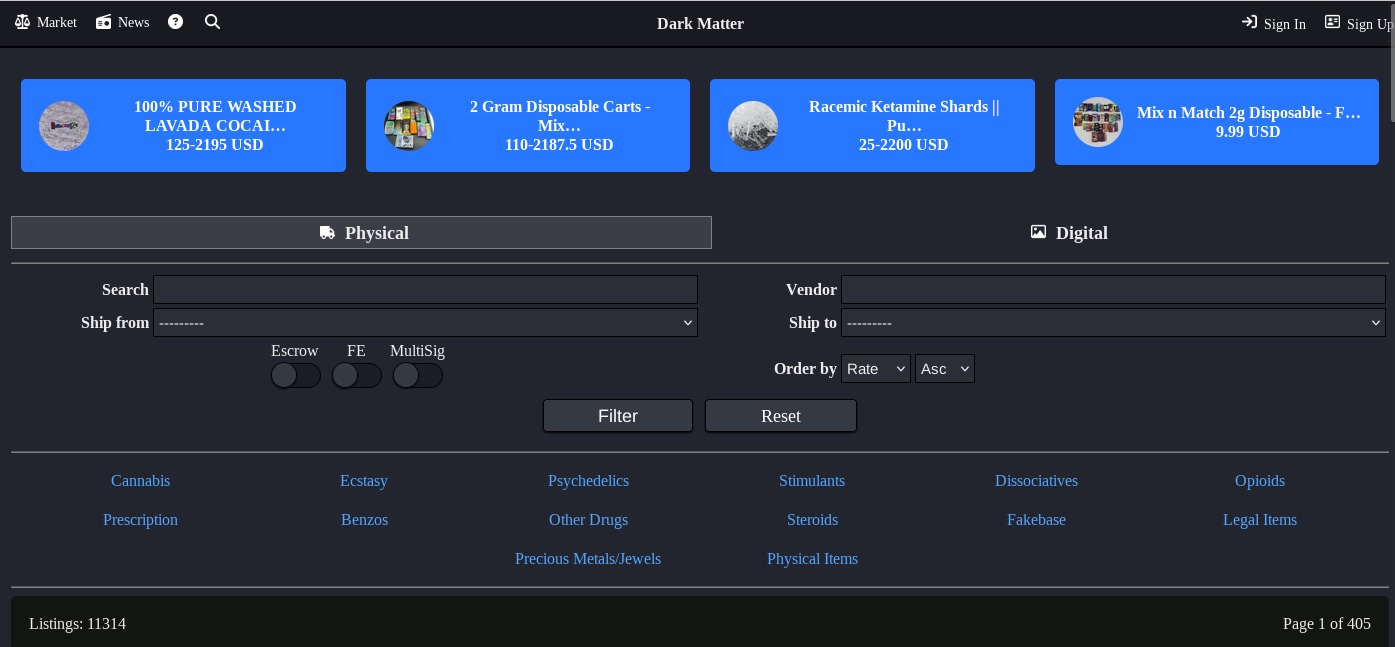
Monero multisig implementations are newer and less battle-tested than Bitcoin's, so "supported multisig" was never the same as "multisig saved everyone." The September 2026 exit is the practical proof: multisig only protected orders actually placed through multisig, and a standing balance in ordinary escrow was still a balance the operator could freeze or walk away with. That distinction is spelled out on the exit scam page using DarkMatter as the worked example — not repeated here.
Walletless operation
DarkMatter described itself as operating without a central deposit wallet, instead handling automatic withdrawals and refunds and supporting anonymous, account-less ordering. The ordinary darknet-market model requires a buyer to pre-fund a balance sitting in the market's own custody before placing an order. Reducing or eliminating that resting balance was a genuine architectural improvement in theory: less money on someone else's server at any given moment. Whether DarkMatter's implementation delivered that in practice was never fully verified from outside — the effectiveness of any such system ultimately depends on how the underlying implementation works, which is the limit of what an outside archive can confirm. Whatever the architecture claimed, vendors and buyers still reported frozen escrow when the market went down — which is the outcome that matters in an archive entry.
Vendor requirements and feedback
PGP was required for every vendor account on DarkMatter, not merely offered as an option for ordinary buyers — a security floor for vendor communications that some other markets left to individual choice. Vendor feedback broke scores into shipping, stealth, quality and communication alongside a written comment field, rather than a single star average. Mandatory PGP meant vendor messages were encrypted; it said nothing about whether a vendor shipped what they listed. The drug-testing information DarkMatter said it integrated into some listings was a harm-reduction feature if the underlying lab results were real, and useless if they were not — the feature's existence did not establish which.
What four years online did and did not prove
Long uptime in this ecosystem is rare, and it is not the same thing as safety. A market surviving nearly four years is consistent with careful operational security — and equally consistent with a long-running honeypot, a possibility one reviewer raised directly rather than dismissing. Longevity also meant four years to build a reputation worth phishing against, which is why the post-exit link problem above is predictable rather than surprising. Dispute and support figures — a stated sub-12-hour response time, disputes monitored on weekdays — were claims made by the operators, not independently measured service levels. The market's specific, checkable design choices — optional multisig, mandatory vendor PGP, walletless ordering — were real and independently described. Its scale numbers were the market's own dashboard, no more auditable then than now. Survival told you the market had lasted. It did not tell you your balance was safe on the day it stopped paying out.
DarkMatter's archive sits alongside RapTor's other market pages for reference. TorZon, DrugHub, BlackOps and WeTheNorth are the active reviews as of this archive date. Nexus is also archived after its own exit in the same month.