 RapTor
DrugHub Market Review: What Its Own Buyers Are Actually Saying Right Now
A DrugHub market review that only counts listings and quotes a fee schedule misses the story entirely: DrugHub's own user base is currently split in public over whether the market is failing its buyers, with named incidents, dates, and a flat disagreement about whether the cause is the market or the phishing sites wearing its name. This page does what a directory page won't — lays out what's actually been reported, keeps the disagreement visible, and answers the one question every thread on this circles without settling: when your money disappears on a market like this, how do you tell a phishing loss from the market itself failing? Below covers access, current status, the address, and the XMR-based marketplace review a reader actually came for.

One URL, no mirrors, no second chance
More than one source reports DrugHub running a single official onion URL over Tor with no maintained mirror network, and that puts the whole weight on getting this right the first time: no backup link to rotate to if you land on a fake, and no second string to sanity-check a suspect one against.topdarknetmarkets.net The address:
drughubfcuiheyswp6hlkggjsigirlzjjk2i7vmcdygceaw2kvzhlfqd.onionConfirm it — and any other address anyone hands you for this market — against a PGP-signed announcement from DrugHub's own Dread presence, not from any single directory's link page, using the same fingerprint-and-signature check covered in full on PGP on the dark web. One reviewer's own stated methodology is worth adopting regardless of which market you're checking: treat every address as temporary, attribute ownership claims to where they were actually announced rather than presenting them as fact, and re-verify rather than assuming links that worked last week still do.onionlink.live
What the exit-scam accusations actually allege
A post to r/DarknetMarketRanks titled "drughub is exit scamming i think," dated 13 January 2026, describes an invoice that expired after payment had already been sent, support unable to locate the transaction afterward, and the review-submission feature becoming unavailable around the same time — the poster's own experience, not a confirmed pattern, though the timing of all three issues together is what drove the suspicion. A reply on that same thread pushes back with a data point rather than a dismissal: the site had reportedly worked normally for that same commenter just hours earlier.r/DarknetMarketRanks, 13 Jan 2026 A separate, more detailed thread — "Drug Hub final review" — collects a buyer's account of three losses across four orders and a conclusion that the market itself is the point of failure, but the top reply on that same post argues the opposite: that DrugHub's passwordless PGP login is among the most innovative security designs running, and that buyers losing money are more likely being caught by a phishing clone than by the market.r/DarknetMarketRanks A third thread, "is drughub a legit market," collects still more contradictory verdicts, including one report of an order and its invoice vanishing after a Monero payment was confirmed sent.r/DarknetMarketRanks
None of that adds up to a settled verdict, and this page isn't going to invent one. What it adds up to is a real, current, public dispute among people who have actually used the market, split roughly between "the market is failing" and "these are phishing losses being blamed on the market." Notably, the directory review that otherwise covers DrugHub in the most operational detail never mentions this dispute exists at all.topdarknetmarkets.net
Telling a phishing loss from a market failure
You often can't be certain after the fact, but three checks narrow it down. First: was the address you used on the market's current PGP-signed list at the time you placed the order? If not, you were never on the real DrugHub, and everything downstream — the invoice, the "support" you contacted — was theater run by whoever controls the fake address. Second: did the invoice or transaction disappear entirely, with no trace even in your own order history, or did it stay visible but simply stop progressing? A transaction that vanishes without a trace looks more like a phishing site that never processed anything real; a stuck-but-visible order is more consistent with a genuine backend problem or a slow support queue on the real market. Third: check whether other users are reporting the identical failure on the same day — a synchronized wave of "my invoice expired" reports across a single market's dedicated forum thread is a signal something changed on the real platform, while a single isolated report is more consistent with that one user having landed on a fake link. None of these checks is conclusive alone, which is the honest limit of what's checkable here at all — see exit scams for the wind-down pattern to watch for if the disruption looks structural rather than incidental.
What DrugHub is, and where sources disagree about it
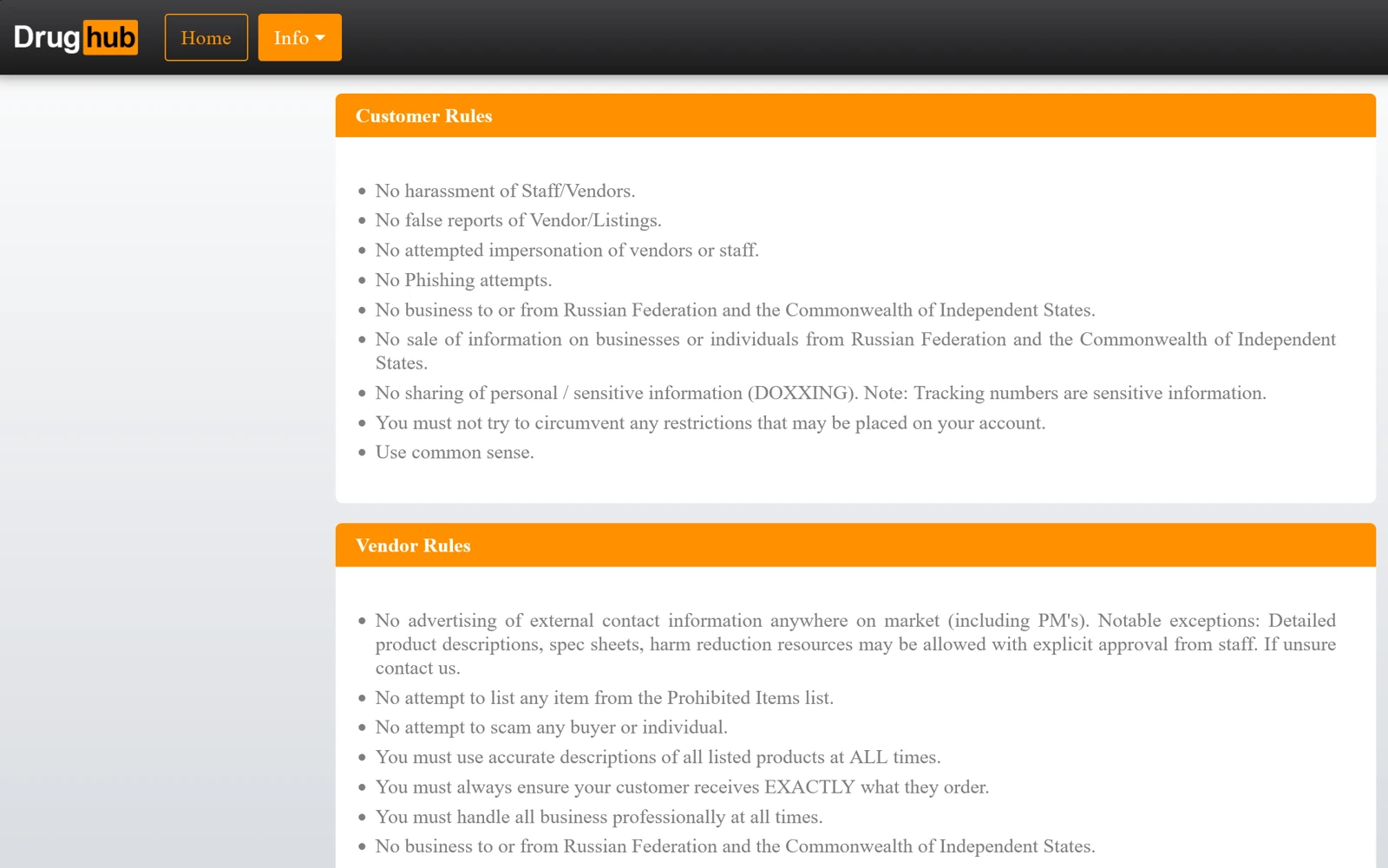
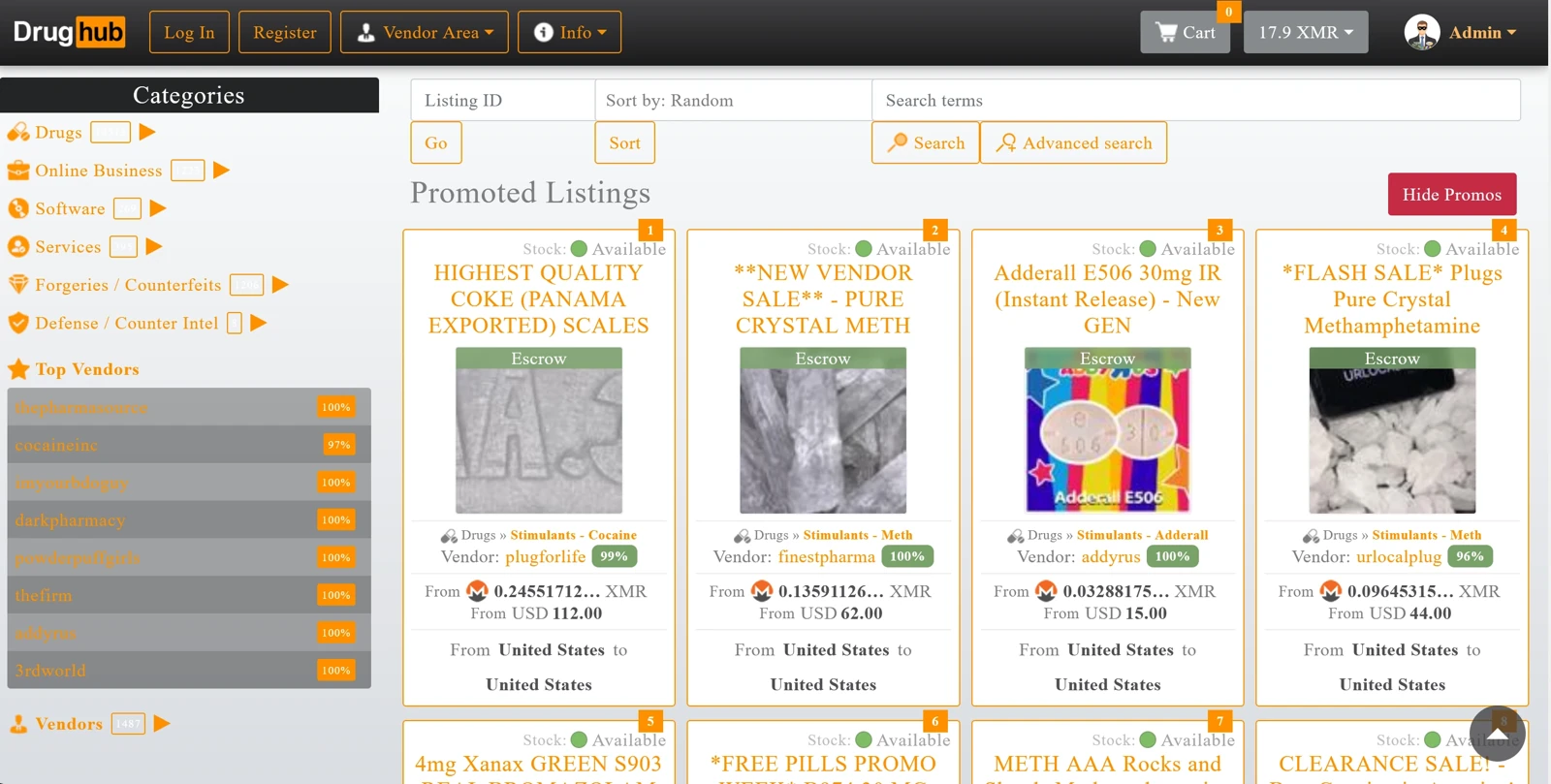
DrugHub was announced on the Dread forum in August 2023 by a user claiming membership in the team behind the now-defunct White House Market, a claim one reviewer is careful to attribute to that forum post rather than present as verified fact, since identity verification is not possible on the darknet regardless of how credible a claim sounds.onionlink.live Beyond that lineage claim, two review sites disagree on something more basic: what the market actually sells. One describes DrugHub as a niche platform that explicitly excludes cannabis, cocaine, heroin and MDMA in favor of prescription pharmaceuticals, research chemicals and nootropics.topdarknetmarkets.net A second, checked roughly five months later, lists a full standard category set including cannabis, ecstasy, opioids and stimulants alongside fraud tools and counterfeits — categories the first source says the market refuses to carry at all.onionlink.live That's not a rounding error between two similar snapshots; it's two sources describing what sounds like a different market under the same name, and it is exactly the kind of contradiction this site refuses to paper over with a confident merged description. Take from it what's actually safe to conclude: DrugHub's category mix has either shifted meaningfully between the two review dates, or at least one of these sources is wrong about the market's basic scope — and a reader cannot tell which from outside.
Where the two sources agree: DrugHub authenticates without passwords. Registration means generating a PGP key pair, submitting the public key, and signing a challenge message to prove ownership of the private key; every subsequent login repeats that signature step rather than checking a password against a database.onionlink.live This closes off an entire category of attack — there is no password database to breach, and no reused-password risk from another site's leak — while opening a different one: lose your private key file, through malware or simple carelessness, and you lose the account permanently, with no password-reset flow to fall back on.
What "walletless" changes for money already in an order
DrugHub is reported to generate a unique, transaction-specific Monero address for each order rather than requiring buyers to pre-fund a standing balance on the platform.onionlink.live That structurally limits the classic operator exit scam, where administrators drain a large pool of resting user balances all at once, because there is no such pool to drain — funds exist per-transaction rather than accumulating in a central market wallet. It does nothing at all about the two other ways money disappears on a market like this: an individual vendor who takes payment and never ships, and the invoice-level failures the Reddit threads above describe, where money already committed to a specific transaction seems to vanish from the buyer's own visibility into it. Walletless architecture is a real defense against one specific failure mode and no defense whatsoever against the other two, which is worth knowing before treating "walletless" as a general safety claim rather than the narrow one it actually is. DrugHub also carries no multisig option, so within any single transaction's temporary escrow, the platform's own process — not a distributed set of keys — decides when funds move.onionlink.live
If an invoice expires after you've already paid
- Do not send a second payment to "fix" the problem. Every account of this failure that circulates describes a first payment that was already sent; sending more does not recover it and doubles the exposure if the address you paid was never legitimate.
- Check the payment address against DrugHub's current PGP-signed list, retroactively, using an independent copy of the market's key. If the address you paid doesn't appear on it, you were on a phishing site, and the "market" you're arguing with about a missing transaction isn't DrugHub at all.
- If the address does check out, contact support through the market's own PGP-encrypted channel with the transaction hash and the exact time the payment was sent — Monero's privacy features mean a transaction hash alone does not prove receipt the way a Bitcoin explorer entry would, so be prepared for that to slow resolution regardless of which side is actually at fault.
- Document everything — screenshots, the PGP-signed messages, the transaction reference — before you lose the ability to, since walletless, per-transaction infrastructure gives support less to look at after the fact than a market with a persistent account balance would.
- If support goes silent and the pattern matches what other users are reporting on the same day, treat it as a possible market-wide event rather than a one-off, and hold off on placing further orders until the picture clarifies.
None of this is easier if you're new to the tools involved — the Tor Browser guide and the Monero guide are worth working through before your first order on any market, not after a payment has already gone missing and you're trying to learn PGP verification under pressure.
Which figures here can actually be checked
One directory review of DrugHub presents an unusually precise set of statistics: 203 disputes over twelve months with a 46% buyer-win rate, a 98.2% uptime figure for a stated quarter, an API-sourced listing count, and a specific German criminal case number tied to a vendor arrest.topdarknetmarkets.net A named court case number is the kind of detail a reader could, in principle, verify through a public record, which puts it in a different category from the dispute and uptime statistics beside it — those come from the market's own systems as reported by a directory with no stated way to audit them, and "98.2% uptime" in particular is exactly the kind of measurement covered on the darknet markets overview that no outsider can actually take. Precision is not the same thing as verifiability; a number with three significant figures attached to it is not more true than a round one, only more confident-sounding.
If you're not willing to take this risk
Given a live, unresolved, public dispute about whether buyers are currently losing money here, the reasonable default for most readers is to wait rather than test it yourself. TorZon and Nexus both carry an operating history without a comparable open accusation at the time of writing, and DarkMatter's 2-of-3 multisig option, covered on the DarkMatter review, removes the specific operator-custody risk that centralized markets share. BlackOps's smaller, more screened positioning is another reasonable alternative if a narrower vendor roster is an acceptable trade for a platform without a live, public exit-scam accusation attached to it right now. If you decide to proceed with DrugHub anyway, keep any single order small enough that an invoice failure or a vendor scam is a loss you can absorb without it being the whole point of the exercise, and re-check its Dread subdread for fresh reports before you send anything — the accusations above are recent enough that the picture may have moved by the time you read this.