 RapTor
Seed Phrase Backup: How to Store One So It Survives Fire, Theft, and You Not Being Around
Search for seed phrase backup and nearly every result is about fixing a phrase that has already failed — a wrong word, a checksum error, a fee-charging recovery service. Almost nothing explains how to make a good backup in the first place, which is the actual question in the query. This page does that: media, copies, splitting, where a passphrase goes, and testing before you fund anything — plus the checksum mechanics, done correctly, for the minority of readers arriving here because a phrase is already failing.
Paper or metal, and when it matters
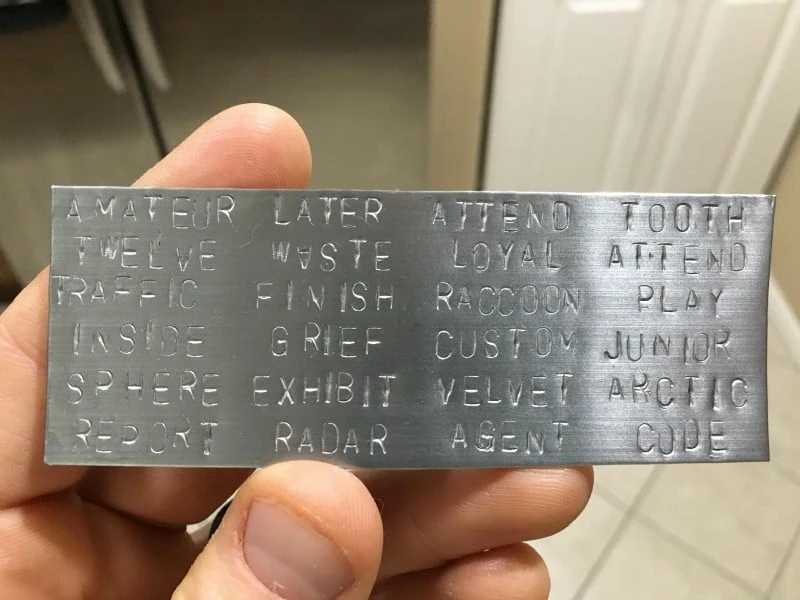
Paper is free, immediate, and vulnerable to exactly the failures that make backups fail: fire, water, and simple fading over years. Metal — a stamped or engraved plate — survives all three and is the better choice for a backup you intend to rely on for years rather than months, which describes most seed phrases the day they're created. The difference matters most in exactly the scenario a backup exists for: a house fire or flood is precisely the moment paper fails and metal doesn't, so the calculation isn't close for any backup protecting funds you'd genuinely miss. It matters less for a low-value test wallet you'll empty and abandon within weeks — a case where paper is a reasonable, honest shortcut rather than a mistake.
How many copies, and where they physically live
Two copies in two separate physical locations is a reasonable floor for anything beyond a trivial balance — one copy protects against loss, but a single copy is also a single point of failure against that same location's fire, flood, or burglary. A common, sound pattern: one copy at home in a secure, fireproof location, and a second at a genuinely separate location — a family member's home, a safe deposit box — geographically distant enough that the same fire, flood, or regional disaster can't plausibly take out both at once. More copies reduce loss risk further and increase exposure risk in exactly the same proportion — every additional physical copy is another location where the phrase could be found by someone who shouldn't have it, so there's a real trade-off past two or three copies, not an argument for maximizing count.
Whether to split the phrase, and why naive halving is worse than not splitting
The instinct to split a backup — half the words in one location, half in another — feels like it spreads risk the way multiple copies do, and it does the opposite. A naive split means either half, found alone, dramatically narrows the search space for the whole seed compared to finding nothing at all, so a thief who finds one location gets most of the way to your funds rather than none of the way. It also means losing either single location makes the backup completely unusable, which is worse than losing one full copy when you still have a second intact one elsewhere. Real splitting schemes — like the multi-share backups some hardware wallets, including Trezor's newer devices, support natively — use actual secret-sharing math where a subset of shares (say, any 3 of 5) reconstructs the seed and no smaller subset reveals anything at all about it, which is a fundamentally different and much stronger property than cutting a 24-word list in half. If your device doesn't support real multi-share backups, don't improvise your own split — keep full, separate copies instead.
How to test the backup before funding the wallet
- Confirm your wallet is genuinely empty, or use a second, spare device for the test — recovering onto a device that still holds real funds risks overwriting a working wallet if something goes wrong mid-process.
- Before resetting anything, note your wallet's first receive address somewhere you can compare against afterward.
- Reset the device to factory settings through its own menu, then choose "recover" or "restore" rather than "create new," and enter the words from your physical backup exactly as written — not from memory, not from a digital copy made "just for this test."
- If you use a passphrase, enter that too; a passphrase-protected wallet only reconstructs correctly with both the seed and the exact passphrase together.
- Compare the restored wallet's first receive address against the one you noted before resetting. A match means the backup is genuinely readable and correctly transcribed; any mismatch means something in the physical copy — a misread letter, a word out of order, a forgotten passphrase detail — needs fixing before you trust it with real funds.Self Custody Labs
Do this before the first meaningful deposit, not after — a backup that turns out to be wrong is a minor inconvenience before funding and a total loss after.
Where a passphrase gets written down
Never with the seed words, and this is the single most common way a passphrase's extra protection gets thrown away. The entire point of a passphrase is that someone who finds your seed backup alone still can't reach the passphrase-protected wallet — storing both together defeats that purpose completely and simply recreates a normal, un-passphrased backup with extra steps. Store the passphrase somewhere physically and logically separate from the seed: a different location, ideally memorized if you're confident in your ability to recall it exactly (capitalization and spacing included, since a passphrase is character-exact), or written down in a place that reveals nothing about which wallet or seed it belongs to if found on its own.
What must never happen to your seed
Never a photograph, even on a device you consider secure — photo libraries sync to cloud services more often than people expect, and a synced photo of a seed phrase is a seed phrase now sitting on a company's server. Never a cloud note, a password manager entry, or any digital file at all, encrypted or not — the whole point of a hardware wallet is keeping the key offline, and typing the seed into any internet-connected device undoes that even if you delete the file five minutes later. Never a website, including a recovery tool that asks you to "verify" your phrase online — no legitimate wallet or vendor process ever needs your seed entered anywhere but directly on the hardware device itself. If you've done any of these, the seed should be treated as compromised: move the funds to a freshly generated wallet rather than continuing to trust a phrase that may already be sitting somewhere outside your control.
Why the last word is a checksum, and what "invalid phrase" means
Under the BIP-39 standard nearly all modern wallets use, a seed phrase is generated by taking a block of random entropy, computing a checksum from its hash, appending that checksum to the entropy, and splitting the combined result into 11-bit chunks that each map to one word from a standardized 2,048-word list.BIP-39 For a standard 24-word phrase, the final word encodes 8 bits of that checksum — which is why software can tell a phrase is invalid the moment you enter it, before ever trying to derive a wallet from it: the words you typed don't produce a checksum matching what the last word encodes. "Invalid recovery phrase" specifically means this checksum arithmetic failed, which almost always traces back to one of three causes: a misread or mistyped word, two words swapped or out of order, or a word from the wrong language's wordlist entirely, since translating a phrase to another wordlist produces an entirely different seed rather than the same one in translation.BIP-39
What you can safely check yourself, offline, when a phrase is rejected
- Recount the words. A phrase must be exactly 12, 15, 18, 21, or 24 words under the standard — any other count is invalid before you even check spelling.BIP-39
- Check each word against the standard English wordlist for a near-miss — the BIP-39 wordlist was deliberately designed so the first four letters of every word are unique, which means a word you're unsure of can be matched to its correct full spelling by its first four letters alone.BIP-39
- Verify you're reading the correct wordlist language — a phrase generated in one language's wordlist will never validate against another's, even if individual words happen to look similar.
- Reconsider the order carefully if spelling checks out. Word order is part of the seed's meaning, not just presentation, and two swapped adjacent words is a common, honest transcription mistake.
- If you're comfortable with an offline, air-gapped tool and it's genuinely never been connected to the internet, a local BIP-39 checksum calculator can confirm validity without exposing the phrase anywhere — but never run this kind of check on any device connected to a network, and never on an online version of such a tool no matter how reputable the site looks.
What not to do: pay a "recovery service" before trying the above yourself. The checksum arithmetic above is something any careful reader can verify with paper, a printed wordlist, and patience — a paid service is solving a problem that free, offline arithmetic usually solves first.
What happens to this when the owner dies
Nothing, automatically — and that's the actual risk, not a hypothetical one. A seed phrase with no instructions attached, known to no one but its owner, means the funds it protects are permanently unreachable the moment that owner is gone, with no company, no court, and no password-reset process able to help, because nobody else ever held the key. A workable plan doesn't mean telling an heir your seed today — it means ensuring someone trusted knows a backup exists, roughly where to find it, and how to use it, without that information being usable by anyone before it's needed. A multi-share scheme, covered above, is a genuinely good fit for this: distributing shares among several trusted people or locations so that no individual share-holder alone can access funds while they're still needed, but the right combination can reconstruct access when the time comes.
Is a 20-word backup the same kind of thing as a 24-word one?
Related but not identical. A standard 24-word BIP-39 phrase encodes 256 bits of entropy plus its checksum.BIP-39 A 20-word backup, as offered by some newer hardware wallets, typically belongs to a different standard — Shamir's Secret Sharing-based schemes like SLIP-39 — built specifically to support splitting into multiple shares later, which a plain BIP-39 phrase of any length cannot do natively.Trezor Both are secure when generated and stored correctly; they are not interchangeable formats, and a 20-word backup won't restore on software or a device expecting a standard BIP-39 phrase length. Know which standard your specific device generated before you assume any general seed-phrase advice — including some of this page's — applies word-for-word.
For choosing the device that generates this backup in the first place, see the hardware wallet guide and setting up a Ledger or Trezor. For keeping this backup from becoming the one thing that links your funds to your identity if it's ever found, the OPSEC guide covers separating this kind of secret from the rest of your digital life. Note that Monero's own 25-word seed is a different format from the BIP-39 phrases covered above — the Monero guide covers what changes.