 RapTor
Omega Market Link: New Onion Address After the October 2026 Move
If your Omega Market link starts with omega7eye, it's the old address, and Omega took it offline on 8 October 2026 after a bug in a tool called GoBalance exposed the key behind it. Directories that haven't been updated still print the old address, and some add a backup that Omega's new notice doesn't mention. The current address is below. After it: what happened, how to check any Omega link, and what the market is like, including coins, fees, escrow, login and weak points.
Omega Market onion address, as of 16 October 2026
This address comes from the signed notice Omega's administrator, Quark, posted on 8 October. Uptime trackers and directories reproduce the notice. RapTor can't verify the signature on your behalf, so use the address as the one to test.
omegat6ntzdz45e4bvgomgmn7ctlpsodkmij6gjilmztmxbedvmeffad.onion| Starts with | Status |
|---|---|
omegaart | Current. The only address named in the 8 October notice. |
m22jreil | Unconfirmed. It comes from an older signed message that also named the retired address. Some directories still list it as a backup, but the new notice doesn't mention it. |
omega7eye | Retired on 8 October. Don't use it, however recent the page that lists it. |
Why Omega dropped its old address
GoBalance is a tool that keeps hidden services reachable under heavy traffic. Searchlight Cyber disclosed on 8 October that a bug in it lets anyone work out the secret key behind a site's onion address from public information alone. Whoever holds that key controls the address and can send visitors to a copy of the site. It doesn't give them access to the real servers or the stored data.The Hacker News, 9 October 2026
A leaked key can't be taken back, so patching isn't enough. The only fix is a new address, which is why Omega moved. Here is the order of events:
- 5 to 7 October: both of Dread's onion addresses were taken over and pointed at a rival site. Dread then moved to a new address and told users to change their passwords.
- 8 October: Searchlight Cyber published the flaw. The same day, Omega's signed note said it had taken its old address offline "due to an issue caused by the GoBalance bug" and moved to a new one.
- 9 October: there was still no CVE number and no advisory from the Tor Project or GoBalance's maintainer.
No public report says anyone actually took over Omega's old address. It was retired as a precaution after the bug became known, and the safest assumption for a bookmark made before 8 October is that it now leads somewhere Omega doesn't control. Dread's operators also warned that other hidden services may be affected. If you used the old address recently, change your Omega password, and change it anywhere else you reused it. The onion services explainer shows why an address is really a key,Tor Project which is the reason a leaked key means a lost address.
How to check an Omega address before you log in
- Read the start of the address. The current one starts
omegaartand is 56 characters before.onion. A start ofomega7eyemeans the retired address. - Check the signed notice yourself. Fetch Omega's PGP key from a site that isn't the one showing you the address, then confirm that the 8 October notice carries a valid signature and names the address you're about to use. How to verify a PGP signature walks through it, and the signing key should match the one on Omega's earlier notices.
- Look at the date. A directory page last refreshed before 8 October is out of date, whatever it says about being verified.
- Avoid links with a referral code. Omega runs a referral program that pays referrers a share of the market's escrow profit on the users they bring in, reportedly 20% to 50%. Promoters have a reason to hand you a link.
- Use the anti-phishing phrase as a second check. You choose it at registration and the real site shows it when you log in. If it's missing or wrong, close the tab. Reviews describe it appearing after you sign in, though, so a copy that passes your traffic on to the genuine site has your password by then. Check the address first.
Once an address passes, bookmark it in a Tor Browser you installed and verified yourself and return only through the bookmark.
What Omega Market is

Omega launched on 10 February 2025, according to its own published material, and uptime trackers list it from the same month. Quark runs it. It's an English-language, multi-category marketplace with worldwide shipping on physical goods, escrow, Finalize Early for trusted vendors, an on-site forum, a games section and a set of harm-reduction pages. It also claims round-the-clock support, which nobody outside the market can test.
Reviews describe the look as dark blue, flat and fast, closer to a modern web app than to older Tor markets, and the screenshot below fits that.
How big Omega Market is, by source and date
| When | Figure | Where it comes from |
|---|---|---|
| October 2025 | About 1,000 listings and 3,500 active users | A directory review |
| February 2026 | 7,267 active users, 216 vendors, 3,824 listings | Omega's own anniversary figures, quoted by a review |
| Later in 2026 | 20,634 active users, 355 vendors, 10,108 listings | Omega's own metrics snapshot, quoted by the same review |
| October 2026 | 7,206 listings | The sidebar total in our screenshot, and a directory that checked that month |
These don't fit together neatly. The numbers count different things, and the market supplies most of them itself. Nobody outside Omega can audit them, so read them as rough size, not measurement. The same applies to the vendor cards that show a figure like "2,746 sales across 8 markets": Omega doesn't say where that number comes from.
Omega coins and fees: Monero first, with Bitcoin and Litecoin converted
Sources disagree on coins. Some describe Omega as Monero-only. Others say Bitcoin and Litecoin deposits are accepted and converted to Monero automatically, and the screenshot's price ticker lists all three. The balance itself is held in Monero. If you deposit Bitcoin, that transfer is still public on the Bitcoin ledger, whatever happens to the coins afterwards.getmonero.org Mars works the same way, and its page explains what conversion hides and what it doesn't.
| Item | Reported figure |
|---|---|
| Sales commission | 5%, flat |
| Withdrawal fee | 1%, flat |
| Withdrawal limits | About 0.05 to 100 XMR, one withdrawal per hour |
| Vendor bond | Commonly cited as €500, non-refundable; waivers for established vendors with matching PGP identity |
| Monero deposits | No minimum; each deposit address is meant to be used once and expires after about an hour; about 10 confirmations expected |
Fund the account from a wallet you control, and don't leave a balance on the market. Buying Monero is covered in the Monero guide, and this page on crypto traces lists what a Bitcoin address gives away.
Escrow, Finalize Early and order timers
Funds sit in escrow until the order completes, and the market holds the wallet. Directory write-ups report no multisig, so the operators control every balance, and an exit would take them all. The exit scam page shows how that has gone elsewhere.
Finalize Early releases the money as soon as the vendor accepts the order. Omega reserves it for vendors with a rating of roughly 4.5 or higher and around a thousand sales. Summaries of Omega's rules describe these timers:
- An order the vendor hasn't accepted cancels automatically after 72 hours.
- Digital orders complete 72 hours after they're marked sent.
- Physical orders complete 10 days after they're marked delivered.
- Either side can reset the countdown instead of letting it run out.
Disputes follow a set routine. Each side can offer a partial refund, and accepting one closes the case. A moderator can be requested after 5 days, and silence for 7 days generally resolves the case against the silent party. If you stop replying, the timers decide for you.
Login, PGP and PIN
Omega leans on PGP. Two-factor login works through a PGP key, and users who upload a key can also log in with it as an alternative. A PIN is required for sensitive actions such as withdrawals and changing your key. Session timers run from 30 minutes to 12 hours. Shipping details are encrypted to the vendor's key automatically, and Omega says its staff can't read them.
Sources disagree on whether PGP is compulsory for buyers. Plan on needing it. To make a key, follow the PGP guide, and do it before you register, not after you've funded an account. Messages older than 15 days are deleted automatically unless you archive them, so copy anything you need.
Forum, games and referrals
Omega puts more on one site than most markets do. The built-in forum asks for an introduction post before full access and carries vendor boards, announcements and harm-reduction threads. A games section lets users play with their balance, and some reviewers see it as a way to keep money on the site. There are also coupons, vendor promotion tools and reward points for quick reviews.
The trade-off is more to attack and more to moderate. The forum covers only Omega, so it doesn't replace Dread for warnings about the wider ecosystem, and the referral payouts explain why so many Omega links come with a code attached.
What Omega lists, and the June 2026 rule change
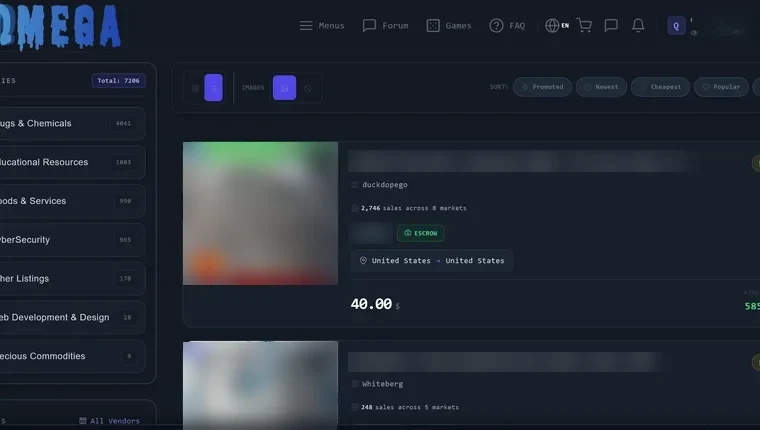
The sidebar splits the 7,206 listings into seven categories: about 4,041 in the largest, which covers physical goods, then roughly 1,003 educational resources, 998 goods and services, 965 cybersecurity, 170 other, 28 web development and design, and 9 precious commodities. Those labels and counts are Omega's own. A category name doesn't prove what's in a listing.
On 1 June 2026, Omega announced a ban on counterfeit items after a report about a face-to-face deal. It promised permanent bans without warning for promoting them, stricter listing filters, and a front page that features only physical products from then on, so digital listings lost their front-page slots. The rules also bar a long list of other items, and they ban deals made outside the platform and contact details in listings or chats.
Is Omega Market legit? Strengths, weak points and warning signs
Whether a market is legit isn't something an outsider can settle. What the record shows: Omega has stayed up for about twenty months, kept to a detailed set of rules and published specific policies, and handled the GoBalance problem within a day of disclosure by retiring the address and posting a signed notice. We found no public law-enforcement case naming it.
The weak points:
- Custody. One wallet, no multisig, so the operators can move every balance.
- Self-reported numbers. Users, vendors and listings come mostly from the market itself, and they don't match across sources.
- Link confusion. Stale directories, an unconfirmed backup, and referral links.
- Infrastructure risk. The same tool that exposed the old address was part of its setup, so one hidden-service bug was enough to force a move.
Signs to treat as a reason to withdraw: delayed withdrawals, timers that stretch, an admin who goes quiet, or vendors saying they've been told to pull their funds. Dread is where those reports appear first. Keep a small balance and place a small first order, and don't use Finalize Early until a vendor has earned it.
Other markets here that take Monero are BlackOps, which is Monero-only, and Vortex, which also takes Bitcoin and USDT. TorZon has the larger catalogue. The directory page puts them next to Omega with dated figures.